
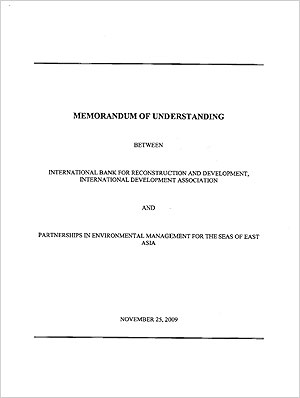
Agreement between IBRD, IDA and PEMSEA in Environmental Management
This memorandum of understanding, also known as the Strategic Partnership Agreement, reflects the understanding between the International Bank for Reconstruction and Development (IBRD) and the International Development Association (IDA), collectively known as the World Bank, and PEMSEA, to collaborately focus on land-based pollution reduction, integrated coastal management, climate change adaptation, and public-private partnerships.
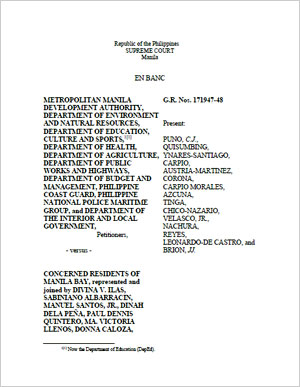
Republic of the Philippines Supreme Court Decision Ordering the Clean-up of Manila Bay
This decision of the Supreme Court of the Republic of the Philippines orders several various Philippine government agencies to clean up, rehabilitate, and preserve Manila Bay, and restore and maintain its waters to SB level to make them fit for swimming, skin-diving, and other forms of contact recreation.
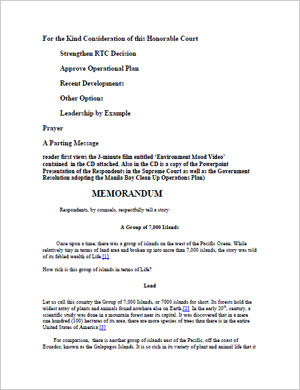
Petition for the Clean-up of Manila Bay
This petition, brought before the Supreme Court of the Republic of the Philippines, asks the court that:
The RTC Decision ordering the clean up and upgrading of the water quality of Manila Bay be affirmed and strengthened.
The Government’s Operational Plan be approved in the mode of a compromise agreement.
An effective monitoring mechanism established to monitor the sustained compliance and report the progress to the Court.
The Government agencies tasked to implement the Law be ordered to lead by example.
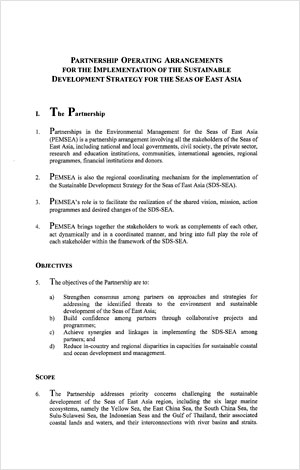
Partnership Operating Arrangements for the Implementation of the Sustainable Development Strategy for the Seas of East Asia
Twelve stakeholder organizations signed the Partnership Operating Arrangements, thus becoming the first group of non-governmental organizations to be formally recognized as PEMSEA Partners for the implementation of the SDS-SEA.
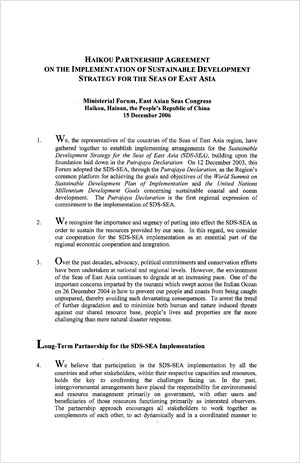
Haikou Partnership Agreement on the Implementation of Sustainable Development Strategy for the Seas of East Asia
The Haikou Partnership Agreement was signed among 11 countries, thereby formally establishing PEMSEA as the regional coordinating mechanism for the implementation of the SDS-SEA. The Agreement also confirmed the countries’ resolve to transform PEMSEA from a regional project-based arrangement to a self-sustained and effective regional collaborative mechanism with a mandate to pursue the implementation of the SDS-SEA through collaborative, synergistic and responsible actions. The digital file includes the Partnership Operating Arrangements for the Implementation of the Sustainable Development Strategy for the Seas of East Asia as an attachment.
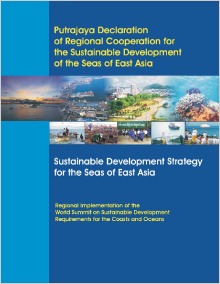
Putrajaya Declaration of Regional Cooperation for the Sustainable Development of the Seas of East Asia
On 12 December 2003, at the Ministerial Forum during the East Asian Seas Congress 2003, concerned ministers of PEMSEA participating countries, as well as representatives of other stakeholder entities, adopted the Putrajaya Declaration of Regional Cooperation for the Sustainable Development of the Seas of East Asia. By adopting the SDS-SEA, the Putrajaya Declaration conveys a regional policy commitment to sustainable development of the seas of East Asia and to forge stakeholder partnership arrangements in addressing areas of concern.
The SDS-SEA provides a regional implementing framework and strategies for achieving the goals of key international agreements and action plans including the UN Millennium Development Goals, the World Summit on Sustainable Development Plan of Implementation, Chapter 17 of Agenda 21 and other international instruments related to coasts, islands and oceans. The SDS-SEA was developed after three years of extensive consultations with the 12 participating governments and 16 stakeholder partners, and embodies a shared vision among stakeholders towards achieving the sustainable use of coastal and marine natural resources, protection of the ecosystems, protection of life and property of the coastal population and sustaining the benefits provided by marine ecosystems. Action programs are developed under six major strategies: Sustain, Preserve, Protect, Develop, Implement and Communicate. On 12 December 2003, at the Ministerial Forum during the East Asian Seas Congress 2003, concerned ministers of PEMSEA participating countries, as well as representatives of other stakeholder entities, adopted the Putrajaya Declaration of Regional Cooperation for the Sustainable Development of the Seas of East Asia. By adopting the SDS-SEA, the Putrajaya Declaration conveys a regional policy commitment to sustainable development of the seas of East Asia and to forge stakeholder partnership arrangements in addressing areas of concern.