Views: Publication - Reports
  • Regional Review: Implementation of the Sustainable Development Strategy for the Seas of East Asia (SDS-SEA) 2003-2011

    The SDS-SEA review process commenced in March 2010. All PEMSEA Country Partners and the majority of the Non-Country Partners participated in the process, which entailed: (a) a desktop review of progress and development in support of SDS-SEA objectives and targets in each participating country; (b) a survey of PEMSEA Non-Country Partners to identify initiatives that contribute, directly and indirectly, to SDS-SEA; (c) conduct of national inter-agency workshops to review and validate the country report, and to build consensus on priorities for SDS-SEA implementation in the medium term; and d) finalization of national SDS-SEA progress reports and preparation of an overall summary report for the region. The countries of the Seas of East Asia have recognized the severity of continuous degradation of their seas, coasts and estuaries upon which the region’s economies and millions of its inhabitants and economies depend. As a reflection of their concern, the governments crafted the Sustainable Development Strategy for the Seas of East Asia (SDS-SEA) in 2003, with the support of Global Environment Facility (GEF) and the participation of United Nations Development Programme (UNDP), the World Bank and 14 other international and regional organizations. The SDS-SEA identifies common threats as well as strategic action programs to reduce the impacts of natural and man-made hazards on coastal and marine resources, as well as the people, communities and economies of the region. There has been considerable progress and achievement on the part of participating countries, local governments and a host of collaborating organizations, programs and projects since the adoption of the SDS-SEA in 2003. The good news is that the region appears to be on track to achieving four major targets as spelled out in the Haikou Partnership Agreement (2006) and further elaborated in the Manila Declaration (2009) (Box 1). However, the bad news is that coastal and marine ecosystems of the region are experiencing increasing threats to the services that they provide humanity. Marine pollution from land-based sources continues to be a serious problem, as evidenced by the expansion of hypoxic (dead) zones from increasing nutrient inputs from sewage and agriculture. International commitments made regarding biodiversity and marine protected areas have fallen short of expectations. Depletion of marine waters through overfishing and use of destructive fishing gear/fishing practices continues. On top of it all, the multiple risks and impacts related to climate change and extreme weather events are becoming more evident. In short, the region has not reached that elusive tipping point where reduction in pollution discharges, conservation and rehabilitation of habitats, biodiversity preservation and enhancement and economic stability have begun to shift the balance in favor of sustainable development. The SDS-SEA review process commenced in March 2010. All PEMSEA Country Partners and the majority of the Non-Country Partners participated in the process, which entailed: (a) a desktop review of progress and development in support of SDS-SEA objectives and targets in each participating country; (b) a survey of PEMSEA Non-Country Partners to identify initiatives that contribute, directly and indirectly, to SDS-SEA; (c) conduct of national inter-agency workshops to review and validate the country report, and to build consensus on priorities for SDS-SEA implementation in the medium term; and d) finalization of national SDS-SEA progress reports and preparation of an overall summary report for the region.


  • State of the Coasts of Guimaras Province

    The State of the Coasts of Guimaras Province, Philippines, was developed to determine the baseline social, economic and environmental conditions and identify priority issues that will be addressed in the Integrated Coastal Management (ICM) Program of Guimaras. The SOC baseline provides the benchmark for determining the impacts of management responses and interventions on the socioeconomic and environmental status of the area. The SOC report may be developed, refined and regularly updated through time to monitor trends and changes that are occurring in the coastal areas of the province, and to refine and adapt policies, management strategies and programs in response to such changes. The report covers the period 2000 to 2009. The report is the output of the combined efforts of different stakeholders of the province, including: the national, provincial, and municipal government agencies; the academe; the private/business sector; the nongovernmental organizations (NGOs) and peoples’ organizations (POs). The data included in the report were validated through a series of field visits to the municipalities. The draft report was presented to the members of the Guimaras SOC Task Team for review and validation on 25 June 2010, the comments and recommendations of which were considered in refining the report. On 14 September 2010, the refined Guimaras SOC Baseline was presented for review, validation and concurrence of the Project Coordinating Committee (PCC).


  • Integrating climate change and disaster risk scenarios into coastal land and sea use planning in Manila Bay

    One of the key issues facing governments throughout the East Asian Seas (EAS) region is the impact of climate change, variability and extremes, particularly in coastal areas. Manila Bay is no exception, with incidents of flooding, storm surges, saltwater intrusion and erosion occurring with increasing frequency or heightened intensity. Of special concern is the threat of sea level rise in the Bay area and its effects on infrastructure as well as social and economic development in the area. The Manila Declaration, which was signed by the Ministers and Senior Government Officials from the Partnerships in Environmental Management for the Seas of East Asia (PEMSEA) Partner Countries in December 2009, called for countries of the region to strengthen and accelerate the implementation of integrated coastal management (ICM) for sustainable development and climate change adaptation in coastal areas of the region. In Manila Bay, the Department of Environment and Natural Resources (DENR) – River Basin Coordinating Office (RBCO), Coastal and Marine Management Office (CMMO) and Manila Bay Coordinating Office (MBCO), and PEMSEA have been working with local government units (LGUs) to scale up the implementation of ICM around the Bay’s coastline, building on the experience of ICM programs in the Provinces of Bataan and Cavite. One of the major thrusts of ICM development and implementation is the preparation of an integrated land and sea use plan. This calls for the conduct of coastal use zoning, which will serve as a guide in the preparation of a plan and regulatory system to allocate the appropriate zones and corresponding uses of the coastal and marine area. Coastal use zoning is based on the functional capability and suitability of coastal waters and land as to the desired uses, the development envisioned by the stakeholders, existing policies and ecological, cultural and traditional considerations. The zoning process is a socio-political matter requiring scientific and technical inputs, involving multi-sector participation and extensive consultation with concerned stakeholders in order to reach consensus on the various zones and their corresponding uses. A major gap in previous meetings and consultations concerning the sustainable development of Manila Bay is the lack of existing and projected impacts of climate change, variability and extremes on the area. Similarly, inputs to the development of integrated land and sea use plans by the local governments in Bataan and Cavite have been lacking guidance and information on changes that are expected to occur because of sea level rise, as well as other potential impacts of climate change (e.g., more intense rainfall or more intense storms). To address this gap, “macro-scale” land and sea use zones for Manila Bay will be prepared with a specific focus on the different scenarios for sea level rise, flooding and storm surges as a consequence of climate change, variability and extremes in the coastal areas over the next 50 years. This document will provide information on climate change, variability and extremes and sea level rise, as inputs to the coastal land and sea use planning and zoning along the Manila Bay area. The physical boundaries of the coastal area to which the Coastal Land and Water Use Plan applies is governed by the Philippine Fisheries Code of 1998 (Republic Act 8550).


  • Sustainable Development Strategy for the Seas of East Asia (SDS-SEA) Implementation Plan 2012-2016

    In 2010, PEMSEA Country and Non-Country Partners agreed to undertake joint planning for the development of the SDS-SEA medium-term implementation plan. The Regional Sustainable Development Strategy for the Seas of East Asia (SDS-SEA) Implementation Plan for 2012-2016 (SDS-SEA Implementation Plan) provides the framework for planning, implementing, monitoring and evaluating the work being undertaken by the PEMSEA Partners and the PEMSEA Resource Facility. It is a results-based, demand-driven plan of action that addresses global and regional issues, incorporates country priorities, and provides a structure for detailed work plans by the Partners, all within the framework of the SDS-SEA. The overall objective is to make PEMSEA's vision and aspirations for sustainable development a progressive reality through tangible and accountable actions, with an annual planning cycle that becomes an iterative process designed to fuel growth and stimulate continuous improvement at the local, national, subregional and regional levels. The SDS-SEA Implementation plan was adopted by eleven Countries of the East Asian Seas (EAS) region as part of the Changwon Declaration towards an Ocean-Based Blue Economy: Moving Ahead with the Sustainable Development Strategy for the Seas of East Asia signed during the 4th Ministerial Forum in Changwon City, RO Korea on 12 July 2012 as part of the East Asian Seas Congress 2012.


  • Port Safety, Health and Environmental Management Code (PSHEM Code)

    The PSHEM Code specifies requirements for an effective port safety, health and environmental management system (PSHEMS) to enable an organization to develop and implement policy and objectives that take into account legal requirements and information about hazards associated with its activities, which have or can have significant risk or impact to safety, health and environment. The PSHEMS is intended to be integrated with other management requirements of the organization, thereby helping to achieve business and economic goals as well. The PSHEM Code is intended to apply to all types and sizes of ports. For this reason, the requirements are expressed in broad terms as guiding principles and objectives so that they can have widespread application. It is for this reason that the PSHEM Code does not state specific port safety, health and environmental protection criteria. The cornerstone of good safety, health and environmental management is commitment from the top management. Furthermore, in matters of accident and pollution prevention, it is the commitment, competence, attitude and motivation of all individuals, at all levels, in every organization that determines the end result.

    Print version is available for FREE. Pay only for the shipping cost.


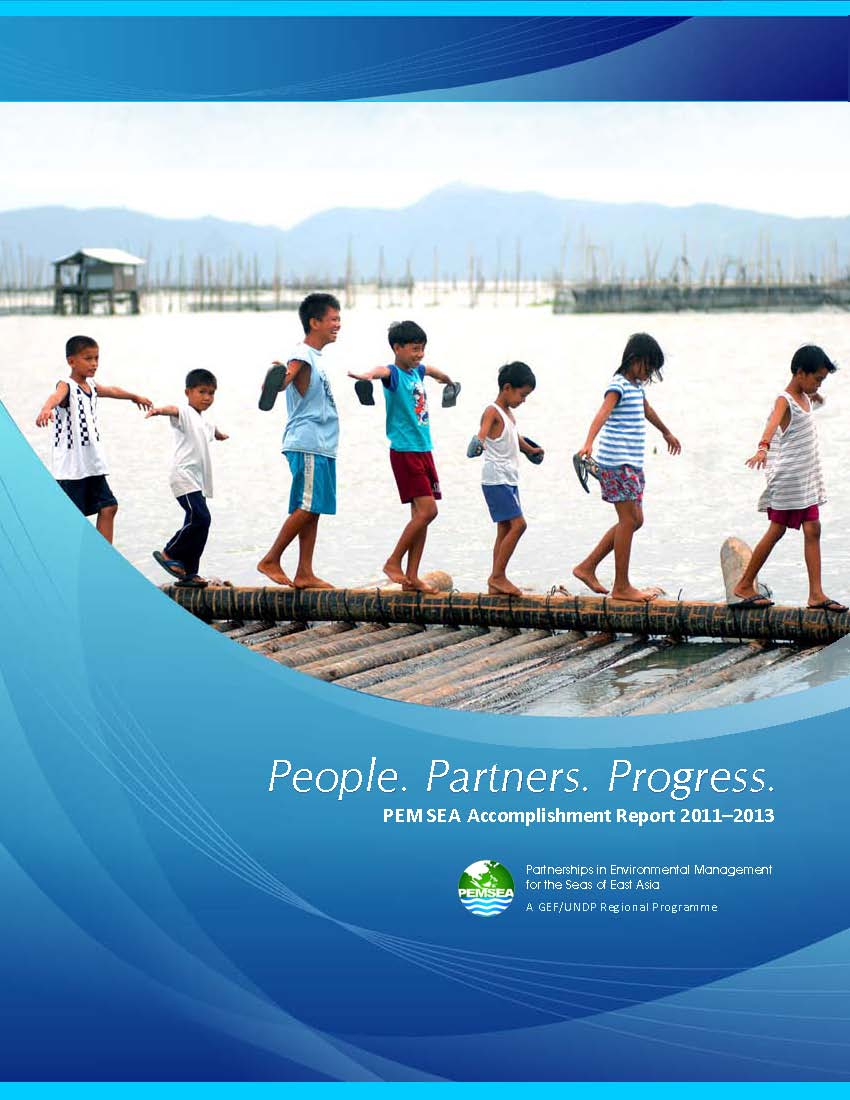
  • Partnerships in Action: PEMSEA Accomplishment Report 2010-2011

    PEMSEA has intensified its transformation into a country and partner-owned self-sustaining and full-fledged international organization. At the same time, PEMSEA continued to work with the countries and ICM sites, as well as with other Non-Country Partners to implement the Sustainable Development Strategy for the Seas of East Asia (SDS-SEA). From 2010 to 2011, PEMSEA illustrated "Partnerships in Action" as it demanded stronger interaction and collaboration between the PEMSEA Resource Facility and the Executive Committee, the PEMSEA Partners, collaborators, and sponsors. This report presents a significant number of accomplishments over these past two years, including improvements in various activities with the local governments, as well as the conduct of the annual PEMSEA Network of Local Governments Forum and Regional Twinning Workshops on integrated river basin and coastal area management. This Report highlights the various collaborative activities and accomplishments of PEMSEA, covering the following: PEMSEA and the SDS-SEA: A Strategic Platform for Sustainable Development of the LMEs and Coasts of the EAS Region PEMSEA's Transformation Strengthening Joint Planning and Implementation SDS-SEA Implementation Enabling Capacities Advocacy Resource Mobilization Challenges
     

  • Development and Implementation of Public-Private Partnerships in Environmental Investments: Terminal Evaluation Report 2011

    The Medium-size Project on the "Development and Implementation of Public-Private Partnerships in Environmental Investments" (MSP-PPP) sought to build confidence and capabilities in public-private sector partnerships as a viable means of financing and sustaining environmental facilities and services for pollution prevention and sustainable use of the marine and coastal resources of the East Asian Seas region. To ensure that both short-term and long-term targets and objectives are met, the MSP-PPP was strategically built within the larger framework for integrated coastal management (ICM). The MSP-PPP was initiated in 2004 and completed in 2009. The project was funded by the Global Environment Facility (GEF), implemented by the United Nations Development Programme, and executed by the International Maritime Organization (IMO) through the Partnerships in Environmental Management for the Seas of East Asia (PEMSEA). This terminal evaluation was commissioned to assess the overall performance, results, effectiveness, and impact of the project, draw lessons from the experiences in different sites, assess the sustainability of results achieved, and identify ways to further enhance future PPP initiatives. The evaluation is in accordance with the GEF Guidelines on conducting terminal evaluations. The evaluation entailed a combination of processes including desk review and assessment of technical and monitoring reports and other studies completed under the project, as well as a visit to one of the PPP project sites – Puerto Galera, Mindoro Oriental, Philippines, wherein interviews with the project implementers from both the public and private sectors were undertaken.


  • PEMSEA Accomplishment Report 2008-2010

    This report presents a number of important accomplishments of PEMSEA from 2008 to 2010 from activities related to: ICM development, implementation and scaling up; various capacity building efforts at the local, national and regional levels; building cooperation through twinning arrangements, public-private partnerships and promotion of corporate social responsibility; development of tools and mechanisms for monitoring and standardization of good practices; and laying out the plans for PEMSEA's transformation and sustainability.


  • State of the Coasts Report of Dongying 2010 (山东省东营市海岸带状况报告)

    Dongying joined GEF/UNDP/PEMSEA Project on the Implementation of the Sustainable Development Strategy of Seas of East Asia (SDS-SEA) as a parallel site to develop and implement integrated coastal management (ICM) programs as early as in 2005. Since then, ICM programs were developed, tested and implemented as means to achieve the goal of balancing economic development and environmental conservation and sustainable use of valuable marine resources. The State of Coast Reporting initiated by the GEF/UNDP/PEMSEA Project in both demonstration and parallel sites across East Asian Sea region serves as a timely opportunity for Dongying to monitor and evaluate the implementation of its ICM programs in a holistic way by examining both governance and sustainable development aspects of ICM programs. The exercise also takes note of the gaps to be filled by its future programs to enable adaptive management for assured on the ground impact of the ICM programs. A total of 32 context-specific indicators are selected focusing on both governance and sustainable development. In order for the assessment team to capture the trends of sustainable coastal development, data from 2005 to 2010 are collected, compared and analyzed to determine the results of ICM implementation as attached in a table. 12 indicators are used to assess coastal governance and 20 indicators are selected in sustainable development aspects. The assessment results of governance aspect appear positive except for the partly operationalized coordination mechanism. On sustainable development aspects, it is obvious that the social and economic sustainability has been greatly strengthened and resource sustainability has improved. As to the environmental safeguard capacity, the areas of natural wetlands, the areas of cleaner sea and level of investment by private sector have markedly declined. This report informs that the future ICM of Dongying should prioritize pollution mitigation, catalyzing environmental investment and rehabilitation of natural wetland through integrated river basin and coastal area management.