
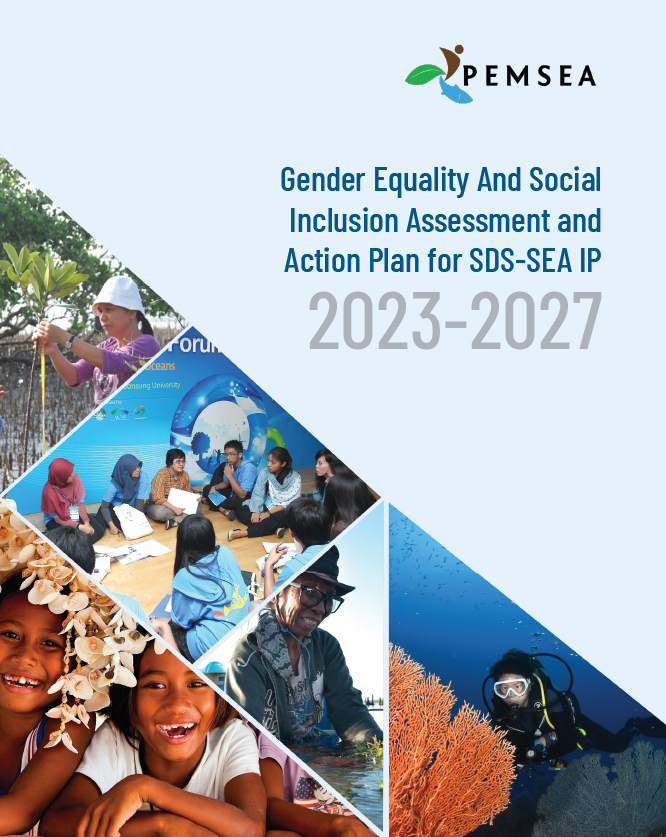
Gender Equality And Social Inclusion Assessment and Action Plan for SDS-SEA IP 2023-2027
PUBLICATION DATE:
Tuesday, January 31, 2023
PUBLICATION TYPE:
Policy Briefs
STATUS:
Only Available Online
DESCRIPTION:
Recognizing the numerous ocean-related challenges in the region, Partnerships in Environmental Management for the Seas of East Asia (PEMSEA) adopted the Sustainable Development Strategies for the Seas of East Asia (SDS-SEA) in 2003. The SDS-SEA is a package of relevant principles, strategies, objectives, and implementation approaches for achieving sustainable development of oceans and coasts of the Seas of East Asia region. In 2015, the SDS-SEA was updated to ensure that it remained relevant to the needs and circumstances of the region and aligned to the post 2015 international and regional commitments and targets.
Integrating the principles of GESI in SDS-SEA IP 2023-2027 is critical to achieving the SDS-SEA IP 2023-2027 Priority Program - Objectives. Women and men use and manage marine and coastal ecosystems differently and have specific knowledge, capabilities and needs related to coastal and marine resources. The work and contributions of women, informal workers and indigenous groups have been routinely ignored or underestimated in coastal and marine research, management and policy, including, but not limited to, their important work in fisheries and aquaculture, in the processing and trading of marine products, in managing plastic and other waste from urban and tourist growth, and in conservation and disaster risk reduction initiatives. Gender equality and social inclusion integration to the SDS-SEA IP 2023-2027 requires identifying and understanding the gaps between women and men in communities, and broader society. It also requires an understanding of discrimination and exclusion based on other identities such as age, physical abilities, race, religion, ethnicity, and socio-economic status.
Based on the GESI Assessment, the SDS-SEA IP 2023-2027 GESI Action Plan was developed to guide the PRF in improving the SDS-SEA-IP 2023-2027 and facilitate the meaningful participation of women, youth, PWD, and other marginalized groups in the Priority Programs of the SDS-SEA. The GESI Action Plan reviews and provide recommendations on mainstreaming gender dimension in the SDS-SEA Implementation Plan 2023-2027, including the identification of gender responsive activities and approaches (ex. the use of disaggregated indicators in state of ocean/river basin reports, gender sensitive finance mobilization, and partner identification to support capacity development and training for PRF, PEMSEA country- and non-country partners, PNLG, PNLC, etc.). The GESI Action Plan will include a section on GESI in the SDS-SEA IP and recommendations in the form of GESI specific policies, activities, outcomes, impacts, indicators and targets where relevant in the SDS-SEA IP itself.
RELATED PUBLICATIONS
INTERNATIONAL SEMINAR ON BLUE CARBON ECOSYSTEM VALUES: Accounting and Crediting Guidance Frameworks
The Korea Maritime Institute (KMI) and Partnerships in Environmental Management for the Seas of East Asia (PEMSEA) convened the International Seminar on Blue Carbon Ecosystem Values in Busan, Republic of Korea. The seminar gathered representatives from six East Asian countries, academic institutions, and regional partners to validate enhancements to the Regional Blue Carbon Accounting Protocol (RBCAP), review biodiversity accounting and crediting approaches, and define PEMSEA’s role in governance, verification, and market development. Key outcomes included expert recommendations to strengthen the RBCAP, shared insights on biodiversity crediting pathways, and a clearer vision of PEMSEA’s added value as a regional platform for advancing blue carbon and biodiversity markets.
The 2026 PEMSEA Network of Local Governments for Sustainable Coastal Development (PNLG) and PEMSEA Network of Learning Centers (PNLC) Joint Learning Forum
The 2026 PEMSEA Network of Local Governments for Sustainable Coastal Development (PNLG) and PEMSEA Network of Learning Centers (PNLC) Joint Learning Forum, themed “Empowering Coastal Cities for a Blue Future,” was organized by the PNLG and PNLC in collaboration with the Korea Maritime Institute (KMI), the Korea Institute of Ocean Science and Technology (KIOST), Coastal 500, and the PEMSEA Resource Facility. The Forum was hosted by the Metropolitan City of Busan, Republic of Korea. The Joint Learning Forum took place on 8 September 2026 at Paradise Hotel Busan as part of the 2026 PNLG Annual Forum (8-10 September 2026). It featured two panel discussions: Local Pathways for Blue Carbon and Nature-Based Solutions, and Capitalizing on Coasts: Financing and Innovating Local Blue Economies.
Proceedings of the 5th PEMSEA Network of Learning Centers (PNLC) Executive Committee Meeting 2026
The document contains the proceedings from the PNLC Executive Committee (EC) held 9 September 2026 in Busan, Republic of Korea.
The meeting was participated in by the President and Vice-President of the PNLC, the PEMSEA Executive Director, and the PNLC Secretariat from IPB and the PEMSEA Resource Facility. The agenda included:
- Workplan 2026-2027
- Updates on PNLC Expenditure and Financial Sustainability
Other Business:
- PRF Project Updates
- 2027 EAS Congress
- ICM Report
- Nature-based Solutions Capacity-building
PEMSEA Blue Carbon Program Updates
PEMSEA eBulletin - September 2026
September connected regional decisions with local action—from a new declaration in Busan to community-led work across the region.
In Busan, the 2026 PNLG General Assembly adopted the Busan Declaration on Promoting Local Coastal Resilience and Sustainable Blue Economy and welcomed Atauro Island, Timor-Leste, as the Network’s newest member. Meanwhile, PEMSEA Founder Dr. Chua Tia-Eng returned to the PEMSEA Resource Facility for a discussion with colleagues on PEMSEA’s history, lessons, and continuing role in advancing sustainable coastal and ocean governance.
PEMSEA project updates include the GEF/UNDP/ASEAN IRBM Project advanced planning for food and biodegradable waste management in the Pasac-Guagua Watershed, while the PRICELESS Project brought stakeholders together in Regions 3 and 4A to tackle challenges and priorities for the Philippine Rise.
In the Philippines and Timor-Leste, MEP partners under the MOF/PEMSEA Marine Plastics ODA Project mobilized communities, schools, government agencies and civil society organizations for International Coastal Cleanup activities, turning awareness of marine plastic pollution into action on the ground.
Proceedings of the Fourth RSC Meeting of the IRBM Project
The Fourth Regional Steering Committee (RSC) Meeting of the GEF/UNDP/ASEAN Project on Reducing Pollution and Preserving Environmental Flows in the East Asian Seas through the Implementation of Integrated River Basin Management (IRBM) in ASEAN countries was held on 08 July 2026 in Vientiane, Lao PDR, in conjunction with the 26th Meeting of the ASEAN Working Group on Water Resources Management (AWGWRM). Co-chaired by Mr. Oudomsack Philavong, AWGWRM Chairperson, and Mr. Gerd Trogemann of UNDP Bangkok Regional Hub, the meeting brought together 55 participants from ASEAN Member States (AMS), the ASEAN Secretariat, UNDP, PEMSEA Resource Facility (PRF), and the East Asian Seas Executive
Committee, both in-person and online.The Meeting reviewed implementation progress of the six participating ASEAN Member States and the regional component, including key achievements, lessons learned, implementation challenges, co-financing delivery, and planned next steps. The RSC also reviewed progress in implementing the approved Mid-Term Review (MTR) Management Response, the preparation of the 2026 Project Implementation Report (PIR), the planned activities for the third and fourth quarters of 2026, and the proposed 2027 Annual Work Plan and Budget, including the proposed no-cost extension of the Project.